
Article: Meet Our Free Soap Calculator (and How to Use It)
Meet Our Free Soap Calculator (and How to Use It)
Every bar of soap I make starts with a little chemistry. Oils and lye only turn into soap in the right proportions, and every oil needs a different amount of lye. Too much lye makes a harsh bar, and too little leaves it soft and greasy. That's why a soap calculator is the most important tool in any soapmaker's kitchen, whether it's your first batch or your hundredth.
I wanted to share one that's simple to use, works on your phone and feels a little more magical than a spreadsheet. I'm a soapmaker, not a programmer, so I teamed up with Fernquill Studio, a small app studio that's also based here on Vancouver Island and the makers of the Aura flashcard app. Together we built the Island Enchantments Soap Calculator, and it's free for everyone to use, with no sign-up needed.
What a soap calculator does
Each oil has a saponification value, or SAP value: the amount of lye one gram of that oil needs to turn into soap. Coconut oil needs far more lye than olive oil, for example. A soap calculator adds up the lye for every oil in your recipe, then takes a little off for the superfat, the small share of oil left unsaponified as a safety margin and for a gentler bar.
It also works out your water, and uses the fatty acids in your oils to predict how the finished bar will behave: how hard it will be, how strongly it cleans, and what kind of lather it makes.
How to use the soap calculator
- Choose your oils. Search 149 oils, butters and fats, or load a classic starting recipe such as Castile, a salt bar or a palm-free beginner bar. Enter each oil as a percentage, or switch to weights.
- Pick your lye. Sodium hydroxide (NaOH) makes bar soap, potassium hydroxide (KOH) makes liquid soap, and a mix of both makes cream soap.
- Set the superfat and water. A 5% superfat and a 33% lye concentration are common starting points for bars.
- Add scents and additives. Enter fragrance and essential oils as a percentage of your oils, and add anything else you use, like sodium lactate or citric acid.
- Weigh out. The weigh-out panel shows exactly how much lye, water, oils and extras to measure, in grams and ounces, with a note whenever something deserves a second look.
Features I think you'll love
- Hot process and liquid soap: add your superfat after the cook, or dilute a liquid soap paste with the right amount of water.
- Fragrance safety: enter the IFRA maximum from your supplier's certificate and the calculator checks each scent against it. IFRA limits are a share of the finished soap, so it compares them with your whole batch, not just the oils.
- Citric acid: it uses up lye, so the calculator adds the extra lye for you.
- Masterbatched lye: if you mix your lye solution ahead of time, it shows how much solution to weigh and how much extra water to add.
- Your own oils: use the exact SAP value from your supplier's spec sheet.
- Batch sizing and costing: fit a recipe to your mould or to a number of bars, and see what each bar costs to make.
- Save, share and print: keep recipes in your browser, send one to a friend with a link, or print a recipe card for your soap kitchen.
Reading the bar qualities
The bar qualities show where your recipe sits against the usual target ranges for bar soap:
- Hardness: how firm and long-lasting the bar is.
- Cleansing: how strongly it cleans. Very high numbers can feel drying.
- Conditioning: how gentle the bar feels on your skin.
- Bubbly and creamy lather: big, fluffy bubbles versus a dense, lotion-like lather.
- Iodine and INS: iodine measures how unsaturated the oils are, and high numbers mean softer bars that can go rancid sooner. INS sums up the balance of the whole recipe.
These numbers describe your oil blend rather than the finished bar, so treat them as a guide and let your test batches have the final say.
Soap safely
Lye is caustic. Wear gloves and eye protection, always add lye to water (never water to lye), and work somewhere well ventilated. SAP values vary a little between suppliers and harvests, so keep your superfat above 1% and double-check any new recipe with a second calculator before you make it. Cold process bars then need several weeks to cure before they're ready to use.
Give it a try
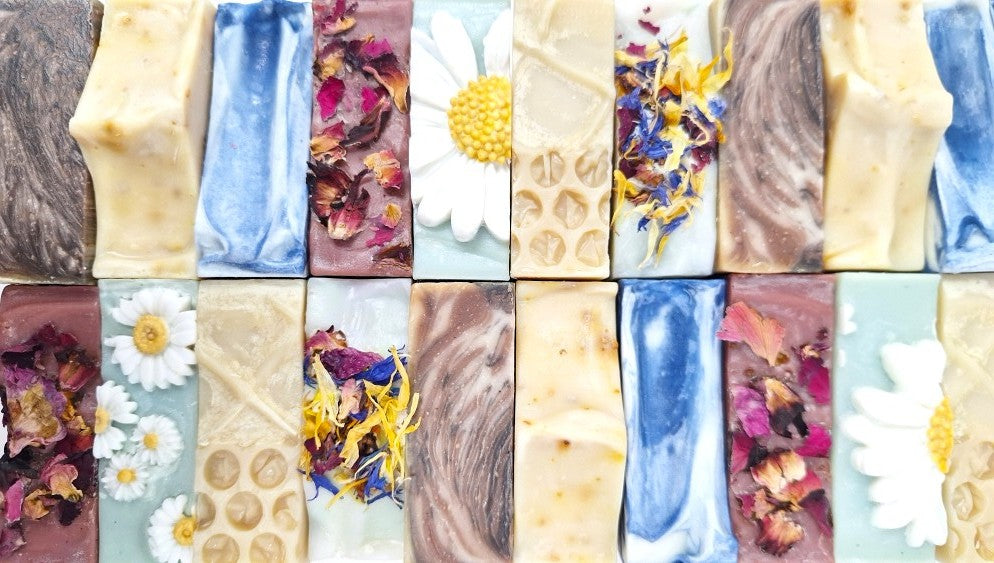
Open the free soap calculator and start from one of the classic recipes, or build your own from scratch. I'd love to hear what you make with it! And if you'd rather leave the lye to me, my handcrafted cold process soaps are made in small batches right here on Vancouver Island.
The Island Enchantments Soap Calculator is an Island Enchantments × Fernquill Studio collaboration.

Leave a comment
This site is protected by hCaptcha and the hCaptcha Privacy Policy and Terms of Service apply.